

Most construction businesses do not have a shortage of data. They have the opposite problem....
Information about clients may sit in CRM. Project financials are held in ERP. Tender information sits within estimating software. Supplier accreditations and compliance information may be managed through specialist platforms. Documents live in SharePoint. Project teams maintain their own spreadsheets. Other valuable information remains buried in emails, shared drives and individual knowledge.
Each system may perform its own job perfectly well.
The problem comes when somebody needs to see the whole picture.
Which suppliers are suitable for this project? Have we worked with them before? Are their accreditations current? What other projects are they involved in? Who owns the relationship? What was their previous performance? Which consultant is influencing the opportunity? Is the project on a framework? What happened on the last similar scheme?
Too often, answering relatively simple business questions means searching across several systems, speaking to different departments or relying on somebody who simply “knows”.
That is becoming increasingly difficult to sustain.
For main contractors, the challenge is no longer simply Customer Relationship Management. It is Project Relationship Management - bringing together the relationships, project intelligence and data that surround every opportunity and project.
The Problem Is Not Data. It Is Disconnected Data.
Construction businesses have invested heavily in technology.
CRM, ERP, estimating, procurement, document management, compliance, health and safety, supply chain and project delivery platforms all generate valuable information.
But these systems frequently operate as separate islands.
Business development might know that a contractor has worked with a particular consultant before.
Commercial may know how a subcontractor performed.
Procurement may hold its approved supplier information.
Finance knows what has been spent.
Compliance teams know whether certificates are current.
Project teams know what actually happened on site.
Individually, each department has part of the answer. Very few people have all of it.
The result can be duplicated records, inconsistent information and significant amounts of manual effort just to establish what the business already knows.
More importantly, valuable information collected during one stage of a project's lifecycle is often unavailable to the people who could use it during the next.
The Project Should Be the Common Thread
Traditional CRM systems typically organise information around:
- Companies
- Contacts
- Opportunities
- Activities
That works well in many industries.
Construction is different because the project provides the context for almost everything.
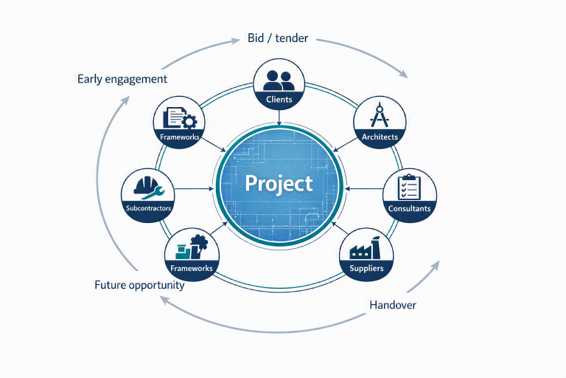
A single project might involve a client, developer, architect, cost consultant, engineer, framework provider, subcontractors, suppliers and numerous internal teams.
It may begin as market intelligence years before a tender is issued and continue through pre-construction, delivery, practical completion, aftercare and future relationship development.
The project therefore becomes the natural point around which information can be connected.
Rather than looking independently at a customer, supplier or contact, teams can begin to understand:
- Who is involved in the project
- What their role is
- Which organisations have worked together previously
- What opportunities and tenders are associated with it
- Which frameworks or procurement routes apply
- Which suppliers and subcontractors are involved
- What previous experience the business has with those organisations
- What relevant information exists elsewhere within the organisation
This is the principle behind a project-centric CRM.
There is an important distinction.
Creating a central view of project information does not necessarily mean replacing every operational system or copying every piece of data into CRM.
An ERP system should continue to manage financial transactions.
An estimating platform should continue to perform estimating.
A specialist compliance platform may remain the appropriate place to maintain detailed supplier certification.
SharePoint may continue to hold project documents.
The opportunity is to connect these sources intelligently.
A project-centric platform can provide the common business layer through which information from different systems is linked, surfaced and understood in context.
For example, somebody reviewing a subcontractor could potentially see not only their contact details, but also the projects they have worked on, their specialist trades, geographic coverage, current compliance position, previous performance and relevant future opportunities.
The underlying information may originate from several different systems.
To the user, however, it becomes one coherent view.
That is a fundamentally different proposition from a traditional sales CRM.
Supply Chain Data Is a Good Example
Supply chain management highlights the problem particularly well.
Information about the same supplier can exist in numerous places across a contractor’s business.
One system may contain company and contact information.
Another contains insurance certificates and accreditations.
Commercial systems hold historic spend.
Project teams maintain performance information.
External providers may hold additional qualification or compliance data.
Estimators and pre-construction teams have their own knowledge about capabilities and previous tender responses.
Then there is the knowledge that exists only in people’s heads:
“They were excellent on that healthcare project.”
“They cover the North West but won’t travel further south.”
“Speak to Sarah – she knows them well.”
“They priced something very similar for us last year.”
This information can make an enormous difference when selecting a supply chain for a new project.
But only if people can find it.
A more connected approach allows contractors to build a richer supplier picture around areas such as:
- Trade and specialist capabilities
- Geographic coverage
- Accreditations and compliance
- Previous project involvement
- Tender history
- Commercial performance
- Quality and delivery performance
- Relationship ownership
- Relevant experience
- Future opportunities
The value comes not simply from storing more supplier information, but from connecting it to the projects where that information becomes useful.
The Same Problem Exists During Work Winning
Disconnected information also affects business development and pre-construction.
The client is obviously important, but they are rarely the only organisation influencing whether a contractor wins a project.
Architects may influence specification.
Consultants can shape procurement strategy.
Framework providers determine routes to market.
Engineers and specialist advisers influence technical decisions.
Supply chain partners provide early pricing and technical input.
Understanding those relationships can be far more valuable than simply knowing the name of the client contact.
A project-centric view allows teams to understand the network around an opportunity:
- Which architect is appointed?
- Which consultants are advising the client?
- Have we worked with them previously?
- Who within our organisation has the strongest relationship?
- Is the opportunity linked to an existing framework?
- Which subcontractors have delivered similar schemes?
- Which organisations appear repeatedly on projects we win?
Instead of relationship intelligence remaining in inboxes and personal experience, it becomes organisational knowledge.
Project Information Should Become More Valuable Over Time
Another weakness of traditional CRM thinking is that CRM is often seen as something that finishes when an opportunity is won.
For construction, that wastes a huge amount of potentially valuable information.
Once a project enters delivery, the organisation starts generating another layer of data.
Project milestones, variations, RFIs, supplier involvement, performance information, completion dates, compliance records, defects and aftercare information can all contribute to the long-term understanding of a project and the organisations associated with it.
That information can subsequently inform:
- Future bids
- Key account planning
- Supply chain selection
- Framework reporting
- Sector strategy
- Project references
- Relationship management
- Risk assessment
A project completed today can provide intelligence that helps win or deliver another project several years later.
But only when that information remains connected and accessible.
From Data Silos to Organisational Intelligence
This is ultimately the bigger opportunity.
Main contractors already collect extraordinary amounts of information across the project lifecycle.
The challenge is turning that information into useful organisational intelligence.
When data remains fragmented between departments and systems, people spend their time searching, reconciling and asking colleagues for answers.
When it is connected around projects, companies, contacts and supply chain relationships, entirely different questions become possible.
- Which consultants are associated with our highest win rates?
- Which subcontractors have the strongest experience in a particular sector and region?
- Which suppliers working on our current projects have compliance items approaching expiry?
- Which framework relationships are generating the strongest pipeline?
- Who within our business has previously worked with the organisations involved in a new opportunity?
- Where have we delivered similar projects before?
These are not simply CRM questions.
They require information from across the organisation.
Construction Needs More Than CRM
Traditional CRM was designed primarily to help sales teams manage customers and opportunities.
Main contractors operate within a much more complicated environment.
Projects sit at the centre of networks of clients, consultants, architects, frameworks, suppliers and subcontractors – while the information associated with those relationships is often distributed across numerous business systems.
That is why KMS developed Project-CRM around the project rather than simply the customer.
The objective is not to create yet another isolated database.
It is to provide a project-centric platform through which relationships and information can be connected – integrating with and surfacing data from the wider technology landscape where appropriate.
By bringing together project intelligence that would otherwise remain fragmented across CRM, ERP, supply chain, compliance and other systems, contractors can create a much clearer view of their business.
The result is less time searching for information, less dependence on individual knowledge and a stronger organisational memory.
And, most importantly, better information is available when people actually need to make a decision.