
Construction isn’t a repeat sales business. You tender for the right to deliver each project, every time. Which means the project, not the customer, not the lead, is where everything comes together. And yet, the data that defines those projects is still fragmented across systems.
Information is spread across CRMs, finance systems, document libraries, emails, and site tools. Each one plays its part, but none of them tell the full story on their own.
This is where things start to break down… Teams spend time searching for information instead of using it.
Key details get re-entered multiple times. Decisions are made on incomplete or outdated data. And when someone asks a simple question about a job, the answer often depends on who you ask.
For many contractors, the goal is to “centralise” everything. But in reality, what they often end up with is a collection of connected systems that still don’t quite join up.
The Missing Piece
Most construction businesses may already have the core systems in place.
- A CRM may be used to track opportunities.
- An ERP handles finance.
- Documents sit in structured libraries.
- Site teams rely on specialist tools for delivery and inspections.
Using the right tool for the right job is absolutely the correct approach.
The issue isn’t the systems themselves… it’s how they’re structured, particularly in CRM.
Traditional CRMs are often built around leads, contacts, and linear pipelines. That works well in many industries, but in construction, it creates a disconnect. Opportunities don’t exist in isolation, they exist within the context of a project.
As a result, each system ends up holding part of the picture, but there’s no single place where everything comes together in a meaningful, project-led way.
So teams create workarounds. Spreadsheets fill the gaps. Knowledge sits with individuals. Processes rely on manual effort to keep things aligned.
It works, until it doesn’t.
Each system holds part of the picture, but there’s no single place where everything comes together in a meaningful, project-led way.
Making the Project the Centre of Everything
This is exactly where a project-centric approach changes things…
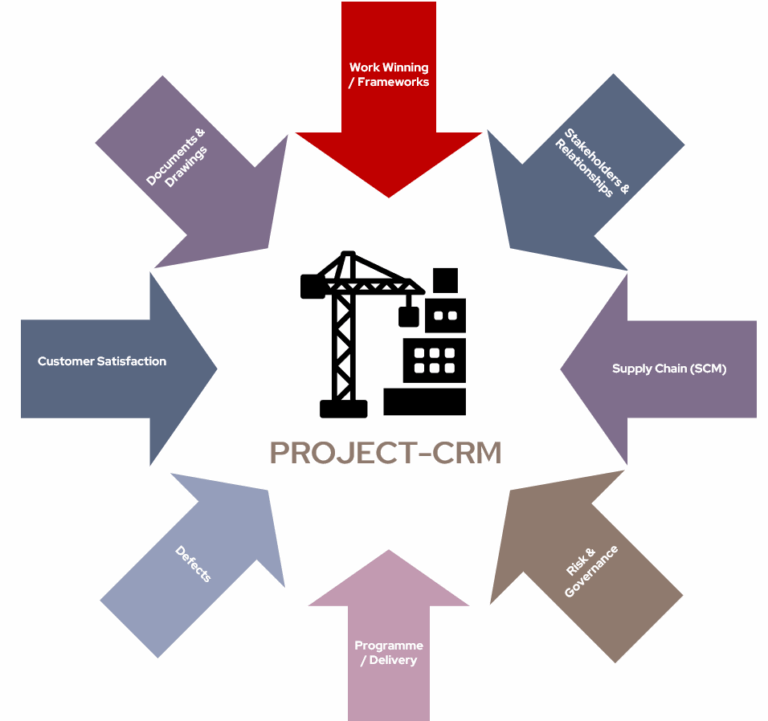
Project-CRM takes a different approach by putting the project at the centre from day one.
Instead of treating it as something that appears later in the process, the project exists from the moment it’s identified, even before a customer is fully known. From there, everything builds around it.
As the project progresses, it becomes the single place where all key information connects. Early-stage work winning activity, stakeholder relationships, supply chain engagement, risk tracking, delivery planning, commercial data, documentation, social value, all tied back to the same record.
Rather than asking where data should live, the question becomes how it relates to the project.
That shift changes everything.

When everything links back to the project, the day-to-day experience becomes much simpler.
You’re no longer jumping between systems to piece together context. You’re not relying on someone’s inbox to understand what’s happened. You’re not second-guessing whether the numbers you’re looking at are up to date.
Instead, the project tells its own story.
You can see who’s involved and how they’re connected. You can track how an opportunity evolved into a live job. You can understand risks in context, not in isolation. You can follow the commercial position alongside delivery progress, not separately from it.
It’s not about forcing everything into one system. It’s about making sure everything points back to the same place.
From Data to Decisions
This becomes even more valuable when commercial data is brought into the picture.
By aligning with finance systems, the project hub starts to provide real insight. Tender values, contract values, costs, and CVR inputs can all be understood in the context of the project as a whole.
That’s when reporting starts to shift.
Instead of being a reactive, end-of-month exercise, it becomes something you can rely on day to day. The numbers make sense because they’re connected to the reality of the job.
A More Practical View of Centralisation
There’s often a push towards having a single system that does everything. In construction, that’s rarely realistic.
Different parts of the business need different tools. Site teams, commercial teams, and finance teams all work in different ways, and the systems they use should reflect that.
The real objective isn’t one system. It’s one version of the truth.

By using the project as the anchor point, you can keep the flexibility of best-in-class tools while still maintaining a clear, consistent view across the business.
Final Thought
If finding information still depends on who you ask, or where you look, then your data isn’t truly centralised.